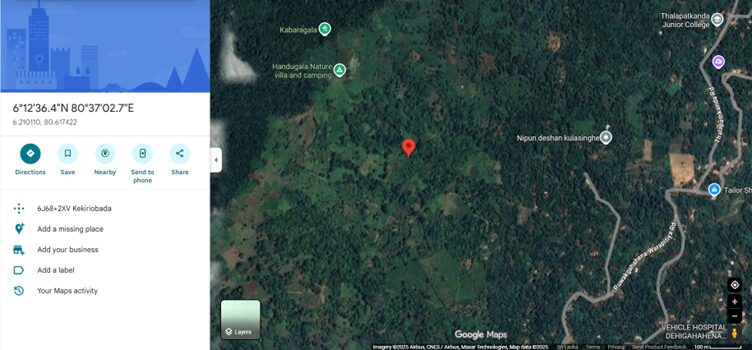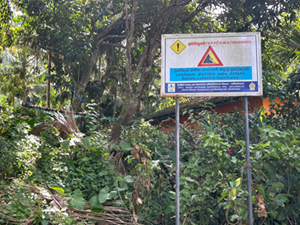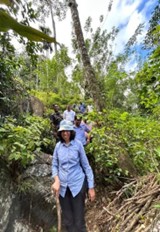
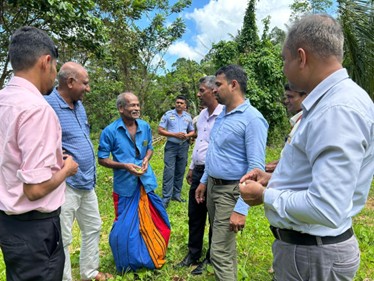
Under the project “Building Resilient Communities through Locally Led Disaster Risk Management Initiatives,” implemented under Asian Disaster Readiness Fund (ADRF) – Pillar I by the Sri Lanka Preparedness Partnership (SLPP), field visits were conducted to Dehigahahena and Saputhanthrikanda in the Walasmulla Divisional Secretariat Division from 03rd June to 05th June 2025. The project focuses on strengthening forecast-based, locally led early warning and early action systems to better protect at-risk, last-mile communities.
These field visits followed the initial coordination meeting with the Walasmulla Divisional Secretariat and were aimed at gaining first-hand insights into landslide-prone and high-risk areas, validating local risk information, and identifying practical entry points for community-centered disaster risk reduction interventions.
Field Visit to Dehigahahena
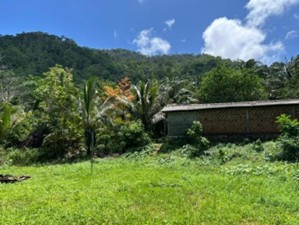
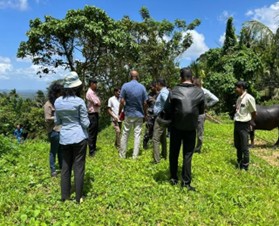
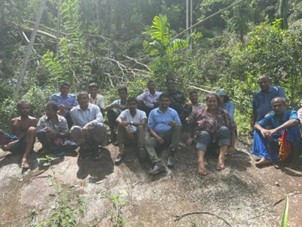
The field visit to Dehigahahena focused on understanding the local hazard context, particularly landslide risks and their impacts on nearby households and infrastructure. The project team, together with relevant local stakeholders, observed site conditions and engaged with community members to understand past incidents, seasonal risk patterns, and existing coping mechanisms.
Discussions highlighted the community’s exposure to intense rainfall events, surface runoff, soil instability, and the absence of localized early warning mechanisms. Community members shared their experiences related to delayed warnings and the challenges faced during heavy rainfall periods, emphasizing the need for timely, locally accessible early warning systems.
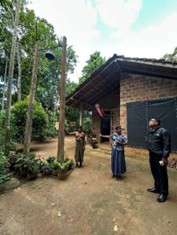
The visit helped identify potential locations for community-monitored rain gauges, manual bell-based warning systems, and the formation of Landslide Risk Monitoring Committees (LRMCs). These insights will inform the design of locally appropriate early action measures and preparedness activities under the project.
Field Visit to Saputhanthrikanda
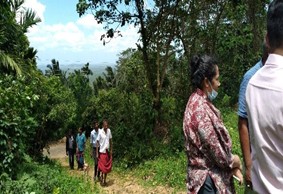
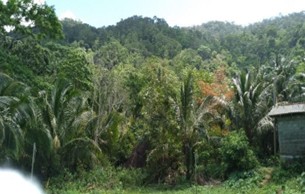
The field visit to Saputhanthrikanda, another landslide-affected area within the division, provided further understanding of terrain vulnerability, settlement patterns, and risk exposure. The team assessed areas previously impacted by slope failures and engaged with residents to document recurring hazards and risk perceptions.
Community discussions underscored the importance of awareness, preparedness, and clear response procedures, particularly during prolonged rainfall. The need for structured Standard Operating Procedures (SOPs) and simulation-based preparedness exercises was emphasized to ensure communities can act swiftly when warnings are issued.
Observations from Saputhanthrikanda also reinforced the importance of extending awareness beyond households to include workers engaged in high-risk livelihoods, such as tree cutting and carpentry-related activities, as well as the need to integrate lightning safety, electrical hazard prevention, and fire risk awareness into community preparedness programmes.
Linking Field Insights to Project Interventions
Findings from both field visits will directly contribute to shaping project interventions in the Walasmulla DS Division, including:
Installation of community-monitored early warning systems
Formation and strengthening of Landslide Risk Monitoring Committees
Development and testing of Standard Operating Procedures through simulation exercises
Targeted community and school-based awareness programmes
Skills training on disaster-resilient construction practices
These field engagements ensured that planned interventions are grounded in local realities, responsive to community-identified risks, and aligned with divisional and district-level disaster management mechanisms.
Way Forward
The field visits to Dehigahahena and Saputhanthrikanda marked a critical step in translating coordination discussions into actionable, location-specific planning. By combining technical assessments with community knowledge, the project continues to promote inclusive, locally led disaster risk management that strengthens resilience and protects lives and livelihoods in vulnerable areas of Walasmulla.