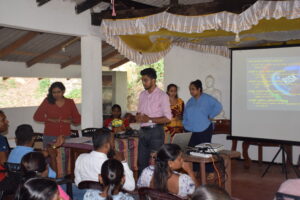
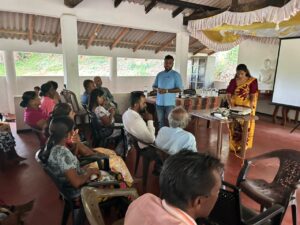
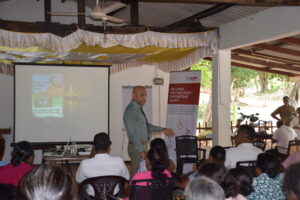
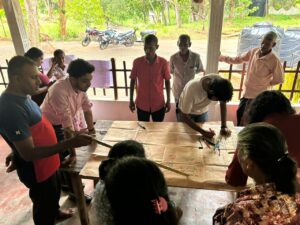
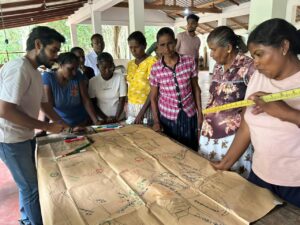
Under the Asian Disaster Readiness Fund (ADRF) – Pillar I project implemented by the Sri Lanka Preparedness Partnership (SLPP), a Community-Based Disaster Risk Management (CBDRM) field programme was successfully conducted on 17 September 2025 in Thulawelliya Grama Niladhari Division, Medawachchiya Divisional Secretariat Division, Anuradhapura District.
The programme was implemented under the thematic area “Enhancing community resilience through Community-Based Disaster Risk Management (CBDRM) approaches”, contributing to the project output of enhancing disaster resilience in the Medawachchiya DS Division through participatory, community-driven disaster management initiatives. The activity focused on improving community understanding of disaster risks and developing a participatory disaster risk management and monitoring plan. The programme was held at Walagamba Aranya Senasanaya, with active participation from community members and local stakeholders.
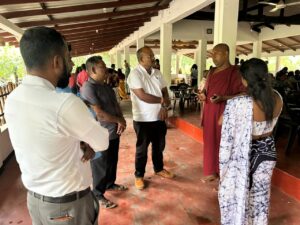
The field programme was attended by over 65 community members from the Thulawelliya GN Division, with women accounting for approximately 60% of participants. In addition, key local-level stakeholders participated, including representatives from the Divisional Secretariat, Development Officers, Economic Development Officers, the Agriculture Officer, an elected local government representative, and other relevant government service providers.
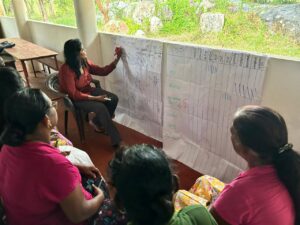
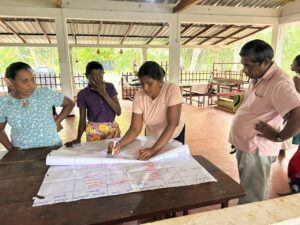
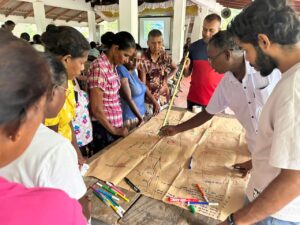
The community meeting applied a range of Participatory Rural Appraisal (PRA) tools to identify local disaster risks and develop a Community Preparedness and Disaster Risk Reduction (CPDRD) Plan. Key activities included hazard and risk mapping to identify danger zones, safe areas, and vulnerable groups; preparation of a seasonal calendar to document periods of floods, droughts, and other hazards; development of historical timelines of major disaster events; institutional mapping through Venn diagrams to understand relationships between service providers; problem ranking and prioritization of key risks; resource and capacity mapping of available local assets; and focused group discussions to ensure the inclusion of women, youth, elders, and other vulnerable groups in the planning process.
This participatory approach strengthened local ownership, enhanced risk awareness, and contributed to building resilient, well-prepared communities in the Medawachchiya Divisional Secretariat Division.