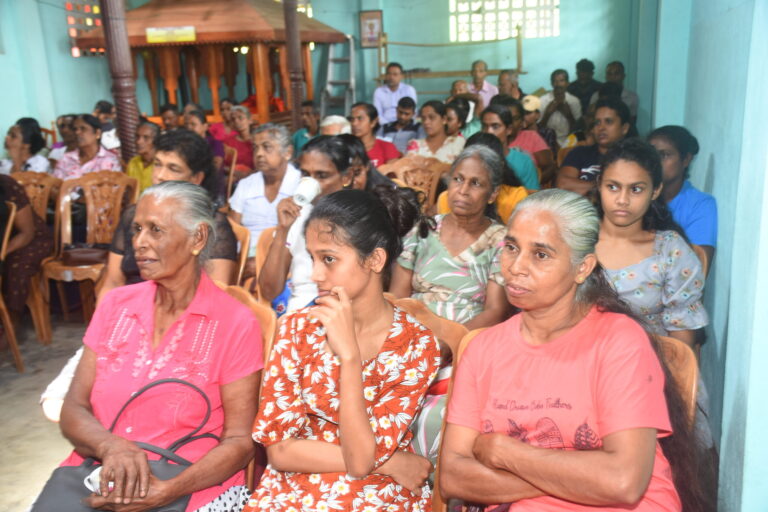
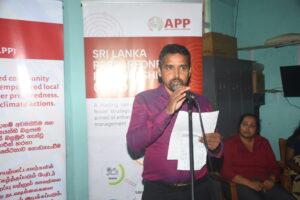
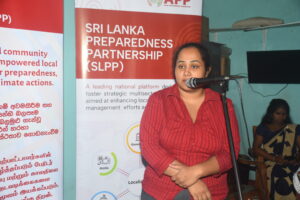
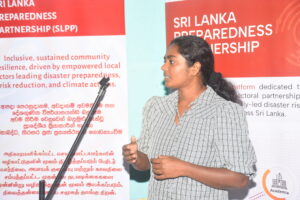
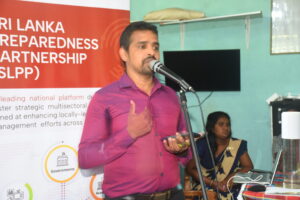
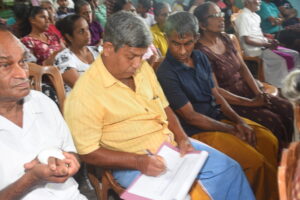
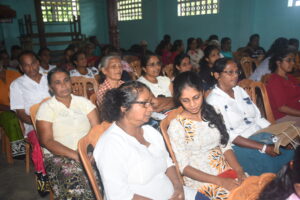
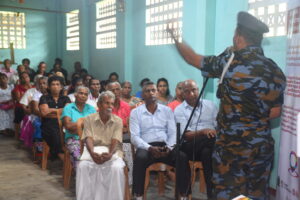
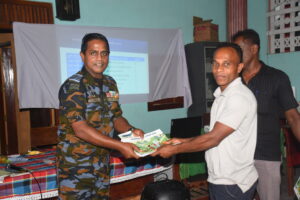
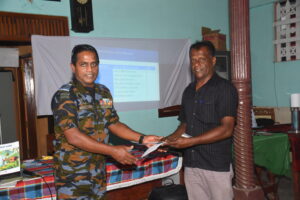
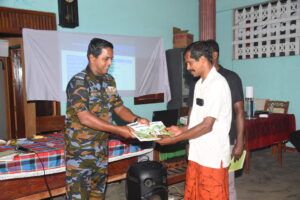
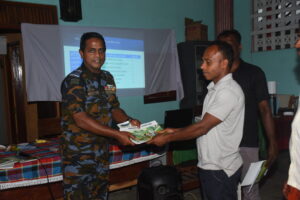
A community awareness workshop on landslide risk management was successfully conducted on 25 November 2025 at Mahindaramaya Temple, Walasmulla, within the Walasmulla Divisional Secretariat Division, Hambantota District. The programme was implemented under the project “Building Resilient Communities through Locally Led Disaster Risk Management Initiatives,” led by the Sri Lanka Preparedness Partnership (SLPP) with financial support from the Asian Disaster Readiness Fund (ADRF).
The workshop addressed the thematic area of strengthening forecast-based, locally led early warning and early action systems to reach last-mile communities. It focused on enhancing community awareness on landslide risks and preparedness, while introducing and strengthening community-based Early Warning Systems (EWS) in the Walasmulla DS Division.
The session was designed to raise awareness on landslide risks, early warning mechanisms, preparedness actions, evacuation and relocation policies, and available social protection schemes, with particular attention to vulnerable communities in Saputhanthri Kanda and Rammale. The programme brought together over 80 participants, with approximately 70% women, reflecting strong female participation in community-level disaster preparedness efforts.
Participants included community members from high-risk Grama Niladhari Divisions, along with relevant local-level officials and civil society representatives. The key objectives of the workshop were to:
Increase community understanding of landslide risks and the importance of early warnings
Introduce the Community-Based Early Warning System, including its purpose, structure, and operation
Strengthen community capacity to monitor, communicate, and respond to landslide threats
Train key community groups, including Landslide Risk Monitoring Committees (LRMCs), on rainfall monitoring, system operation, and coordination with authorities
Technical facilitation was led by the National Building Research Organisation (NBRO), with support from the District Disaster Management Coordination Unit (DDMCU) – Hambantota and the National Disaster Relief Services Centre (NDRSC). Expert guidance was provided on landslide risk assessment, early warning mechanisms, disaster management procedures, relocation policies, and social protection schemes.
Conducted in alignment with NBRO’s Community-Based Landslide Risk Management (CBLRM) approach, the full-day programme strengthened institutional–community collaboration and advanced locally led, sustainable disaster risk management within the Walasmulla Divisional Secretariat Division.